

 Doprava zdarma na tisíce položek
 100% bezpečné online platby
 30 dní možnost vrátit zboží
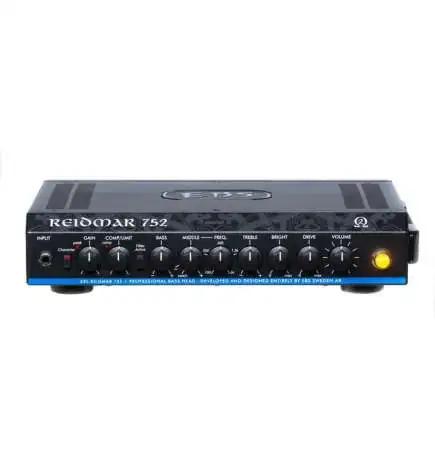
With the EBS Reidmar 752, the Swedish bass specialists present the revised version of their flagship amp, which packs top-class Bass sounds with enormous power reserves into an extremely portable head. While the extensive setting options of the analog preamp make the appropriate clean and overdrive tones available for almost any genre, the Class D power amp specially developed for the Reidmar 752 Head with up to 750 watts of power promises sufficient volume reserves for large and small stages. Last but not least, EBS completes the Reidmar 752 head with extensive connections for seamless integration into live and studio environments.
The heart of the Reidmar 752 is undoubtedly the elaborately designed analog preamp with Soft clipping technology and Tube Emulation Circuit, whose extensive setting options provide the right sound for almost any genre. While the gain control with peak LED significantly simplifies the leveling of electric basses with active and passive electrics, the fast-responding compressor/limiter with adjustable ratio helps to compensate for unwanted level peaks. In addition to the Character switch, which provides a permanent boost to the bass and treble of the basic sound, the Reidmar Head from EBS has a particularly flexible equalizer with semi-parametric mid-band and Bright control, and the sound character can be precisely adjusted. The Drive control also elicits juicy overdrive sounds from the head via the Tube Emulation Circuit.
In the power amplifier of the Reidmar 752 top EBS Sweden relies on a Class D power amp specially developed for the bass amplifier, to which bass cabinets with a minimum impedance of 2 ohms can be connected without any problems. Up to 750 watts of power also promise enormous power reserves for large or small stages and a powerful sound image with clean output of the lowest frequency ranges.
Last but not least, the Reidmar 752 features a number of convenient connections that allow the head to integrate seamlessly into live and studio environments. A serial effects path allows external bass effects to be looped into the signal path, while the unbalanced line out routes the full-range output signal to additional amplifiers or powered monitors depending on the volume control. The balanced XLR output, on the other hand, is suitable for passing the bass signal to mixing consoles, recording equipment and audio interfaces without any side noise, with the tap taking place in front of or behind the Equalizer . In addition to the headphone jack and Aux In for silent playback of E-Bass or backing tracks, there is also a SpeakerTwist jack for bass cabinets and two jacks for optionally available footswitches.
Parametry