


 Doprava zdarma na tisíce položek
 100% bezpečné online platby
 30 dní možnost vrátit zboží
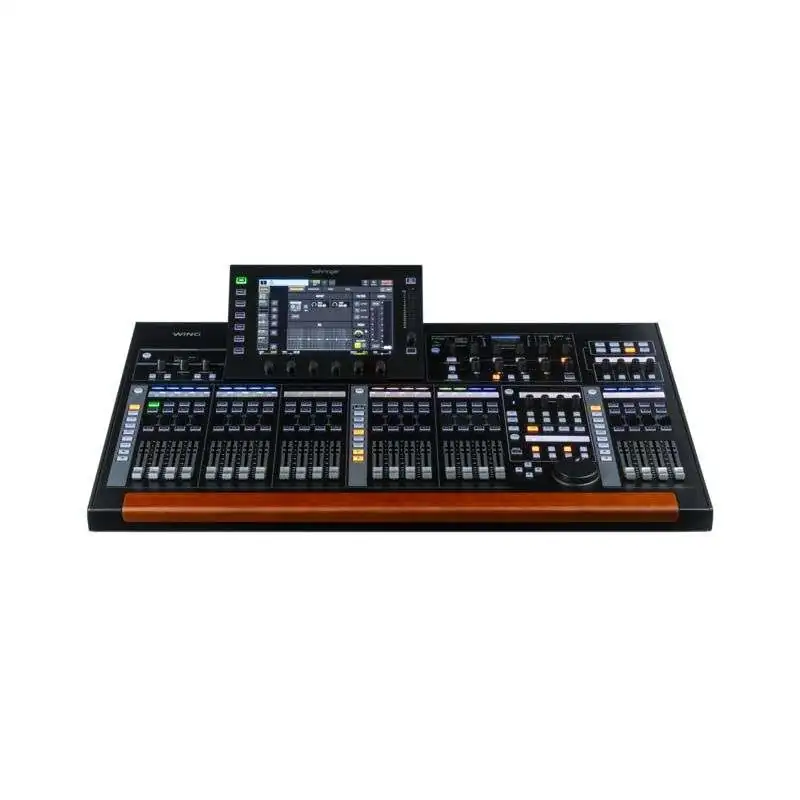
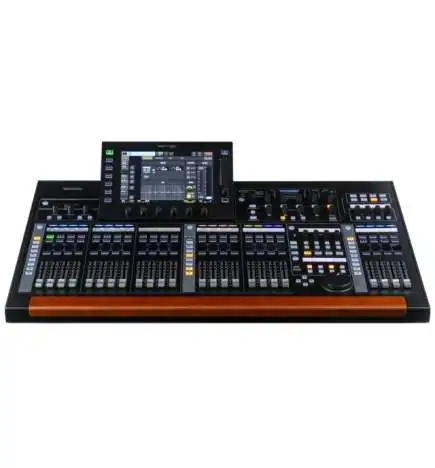
The WING-BK in black is a digital mixing console with 48 input channels, 16 stereo busses, 4 main outs, 8 matrix busses, a user interface with 24 motorized 100 mm faders and a 10" touchscreen display. The digital console is based on the successful Behringer X32 platform and extends the possibilities and ease of use of a digital mixing console in every respect.
The Behringer Wing has 48 mono/stereo input channels. Each input channel can be connected to a main or alternative source. Each input signal of the 48 mono/stereo input channels is automatically used in mono or Stereo depending on the mode of the source. It is also no longer necessary to mix input channels with a stereo pair. Each channel audio can then be sent to the busses or mains for mixing respectively tapped individually to connect the outputs directly.
The Wing also includes 16 stereo busses and 4 main outs. The 16 stereo busses are typically used for send-like effects processing or monitor mixing and are often sent to one of the 4 main outs. Both busses and mains can be sent to matrix, user signals or output destinations.
An additional 8 Maxtrix busses can be sent to user signals or output destinations. They are often used for sub or zone mixes.
The Wing shines with a control surface of 24 motorized 100 mm faders, divided into 3 sections, each equipped with BANK buttons. The group of 12 faders on the left side of the digital mixer is mainly labelled for input channels, the group of 8 faders in the centre typically controls busses and DCAs. The small group of 4 faders on the right side is intended for main or matrix outputs. However, there are no restrictions on the configuration of the fader banks.
For a better overview, each fader has a mini display, the so-called scribble strip. These screens show information about the current channel and bus number, the name and a graphic symbol so that you can quickly recognize which channel is controlled by the fader and the associated buttons. A colour bar above the scribble strip also allows quick visual identification of groups of related channels.
The most important operating elements are edited or monitored via the 10" touchscreen display. The display of the digital mixing console can be set up mechanically and adjusted in angle. The 7 control buttons on the left-hand side of the touchscreen display can be used to access the various displays.
6 encoders at the bottom of the screen allow fine parameter adjustment of the displayed elements. An additional 7th encoder and a multifunction button on the right-hand side of the screen can be used for context-sensitive control.
The navigation arrows and scrub wheel perform functions related to DAW control and the USB audio and WING LIVE players. The scrub wheel can fine-tune the values of the parameters assigned at the user level of the Custom controls.
The Behringer WING-BK also has a type A USB port on the left-hand side next to the touchscreen display. This can be used to connect a flash drive directly to the digital mixing console to save or load data. For example, a backup of the show files can be created or a familiar setup can be loaded. The USB port also enables the recording and output of audio files. The port can charge a portable device such as a smartphone or tablet.
Furthermore, the Wing also has dedicated level controls for the headphone outputs and the monitor outputs (which are set to aux output 7/8 on the rear panel by default). The talkback microphone level can be adjusted via the TALK LEVEL control, and the TALK A and B buttons send the talkback signal to different destinations. Either channel 40 or Aux 8 can be used as the input for the talkback channel.
The built-in Channel Strip provides quick access to the primary parameters for the currently selected channel. The display screen provides specific editing details for the parameter being adjusted and various displays for input configuration, bus and group assignment and metering are visible at all times. One of the 7-channel edit blocks (including EQ) of the Channel Strip section can be sent directly to the edit screen by pressing the corresponding button or touching the capacitive rotary knob above it.
The additional 4-channel section above the right fader section offers a special control area with 4 rotary knobs, 4 control buttons and parameter displays for eg. Gain, Pan or Filter. By pressing one of the 8 buttons, the 4 knobs and 4 control buttons can control the channel properties without selecting the channel for editing. This makes the 4-channel section independent of the main control surface.
The Custom Controls allows the configuration of up to 4 knobs and 8 control buttons to control specific elements that should be available at all times regardless of the focus of the main screen. A common use could be the Reverb Send Level of the vocal channel. The presets can also be configured for different sets, venues, operators, etc.
The analog connections on the rear of the Behringer Wings include 8 microphone preamps and 8 XLR outputs from the excellent MIDAS PRO series as well as 8 balanced ¼" aux inputs and outputs. A connector for a lamp accepts a standard 12 V lamp. The 5-pin MIDI IN and OUT sockets enable external MIDI control. Two ¼ " TRS sockets for GPIO enable basic input and output commands.
Ethernet ports enable a network to be set up via a router for wired or wireless control using one of the control apps for PC, smartphone or tablet. A USB port enables bidirectional 48-channel transmission as well as firmware updates and data exchange. An ASIO driver can be downloaded from behringer.com.
A total of 3 AES50 ports can each provide up to 48 input and output channels to and from digital stageboxes, ensuring ample channel count and allowing patching from multiple locations. The Behringer WING-BK is fully compatible with all X32 series mixing consoles and stage boxes.
Finally, the console supports StageCONNECT, a proprietary connection for transmitting up to 32 audio channels via standard XLR and DMX cables. The interface supports various bus configurations of input and output channels and uses digital, uncompressed PCM with 44.1/48 kHz and 24-bit resolution. StageCONNECT is designed for flexible connections on stage using standard microphone cables that support a wide range of stage boxes and monitoring systems with a latency of less than one millisecond. Stereo AES/EBU input and output connections can be made via XLR cables.
The Behringer WING-BK comes with the WING-LIVE card installed, allowing up to 64 channels of 48 kHz / 32 bit audio to be recorded to 2 SD or SDHC cards. An expansion card for the Dante network is also available.
To make patching easier even in dark locations, Behringer has included patchbay lighting. There is an LED strip on the back for better illumination of the connections.
Parametry