

 Doprava zdarma na tisíce položek
 100% bezpečné online platby
 30 dní možnost vrátit zboží
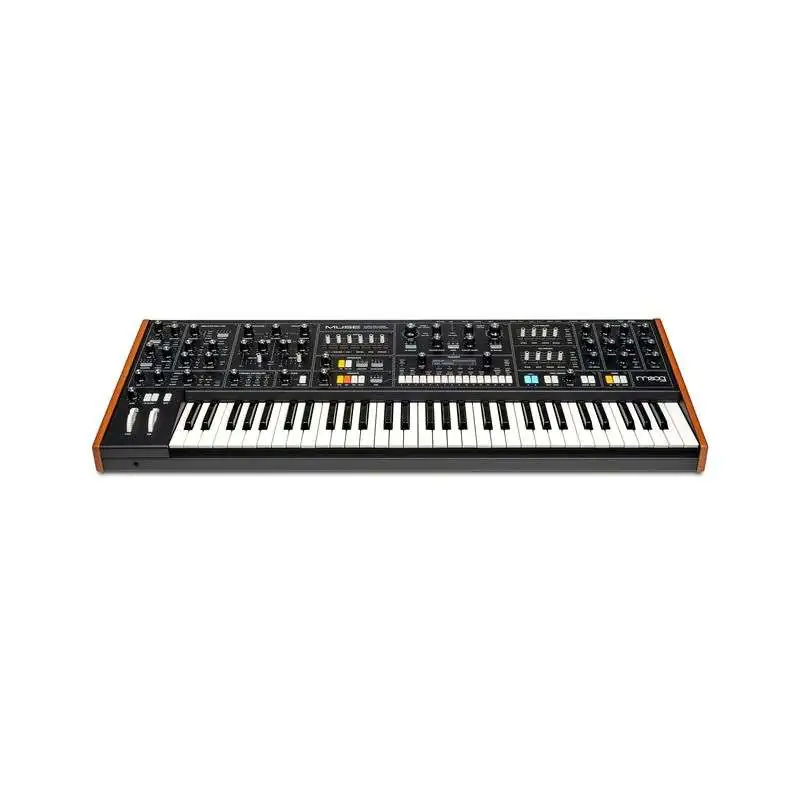
The Moog Muse joins the manageable series of polyphonic Moog synthesizers. With its predecessors Polymoog (1975-1980), Memorymoog (1982-1985) and One (2018-2024), the Muse is only the fourth polysynth in all the decades of the company's history.
The Muse shines with a pleasantly playable 61-key keyboard, which is equipped with velocity and aftertouch. Visually, the Muse is a real eye-catcher, the successful Mix of rotary knobs, faders and various buttons merge into a tidy control panel that has a lot to offer in terms of innovations and versatility of the function groups. The stylish wooden side panels round off the exterior in classic Moog style. For almost every function group, there is a small triangular button that takes you directly to its own menu with further setting options. The Muse can be played twice multitimbrally, meaning it can output two different sounds simultaneously within the eight-voice polyphony. In addition, a split point can be defined, alternatively the parts can also be stacked, phenomenal! Oh yes, unison for ultra-fat 16-24 oscillator solos and mono mode for classic retro mono sounds are also implemented.
In addition to the excellent sound and the extensive synthesis features, performance features such as the programmable arpeggiator, the ingeniously simple chord mode and the polyphonic step sequencer should also speak for the Muse. The patterns can have a length of up to 64 steps and can be used independently of the patches. With 256 presets, there is plenty of memory for your own sound creations. Those who prefer to work without presets or simply need the current settings from the control panel can activate panel mode.
The consistently analog signal path in the Muse starts with two oscillators that have mixable and morphable waveforms. On the one hand, you can crossfade continuously between triangle and sawtooth, and on the other, square wave with PWM is offered. Both can be mixed together via Crossfader , offering an even greater selection of variable waveforms. Hardsync can be switched between the two tone generators and oscillator FM can be finely dosed. The third oscillator, also known as the modulation oscillator, is completely different in terms of technology and structure. It offers five waveforms for easy selection and is basically a well-equipped VC-LFO that extends far into the audio range. Four destinations can be modulated directly in the modulation oscillator. All three oscillators as well as a noise generator and the ring modulator end up in the signal mixer. This is much more than just a multi-channel volume control, as it is very similar to the CP-3 mixer from the old Moog modular system. In other words, this transistor mixer is capable of roasting the signal sources properly and distorting them to a musical level. Part of the mixer is an overload circuit that really makes the signal clip. How could it be otherwise with Moog, the mixer is followed by the filter, in the Muse there are actually two. Both are transistor ladder filters, the first is switchable between highpass and lowpass, the second is a pure Lowpass filter. The characteristic sound of the Moog filters is of course also fully expressed in the Muse. A special feature of the dual filter is the changeable filter routing. Serial, parallel and Stereo are available as alternatives. Together with the stereo VCA, this allows you to create exciting sound shifts in the stereo field and filter progressions that are rather atypical for keyboard Moogs, but sound excellent. The great sound of the Muse is completed by the Diffusion Delay effect, a hypnotic stereo processor inspired by digital rack delays with diffuse multi-tap behavior from the golden era. With the Low Cut control in the Output stage, the bass range can be tamed a little without having to adjust the rest of the signal path; very practical when things need to happen quickly in live situations!
In terms of modulation, the Muse is Moog's most comprehensive creation to date. The two ADSR envelopes are pre-wired to the filters and the VCA. By using the modulation matrix, their range of application is significantly extended, and each ADSR can also be set to loop mode. Two similarly structured LFOs with five switchable waveforms are quickly connected to any parameter. A third LFO with a variable waveform deals exclusively with pitch and vibrato. With the aforementioned modulation oscillator, the Muse has a total of four LFOs that can be used to breathe life into any sound in no time at all. Additional sources and destinations are linked together in the modulation matrix with 16 slots. This makes it possible to create far more complex sounds than the control panel would suggest. The Assignable Controllers focus primarily on keyboard players, as the typical keyboard modulation sources such as eg. Modulation wheel, Velocity or Aftertouch are assigned to a target.
In terms of connections, you'll find everything you could possibly need at Studio and on stage: MIDI In/Out/Thru and USB MIDI for note and data exchange with the DAW and other MIDI instruments, two pedal inputs for Volume and Expression as well as a stereo output round off the features. If you want to use the Muse together with a modular system or semi-modular synthesizers, you can do this quickly with the clock inputs and outputs as well as two control voltage inputs and outputs. How about modulating the dual filter with the two generative sequencers of the Labyrinth synthesizer or sending Velocity and Aftertouch to the Subharmonicon?
Parametry