





 Gratis fragt på tusindvis af varer
 100% sikre online betalinger
 30 dage til rådighed til at returnere varerne
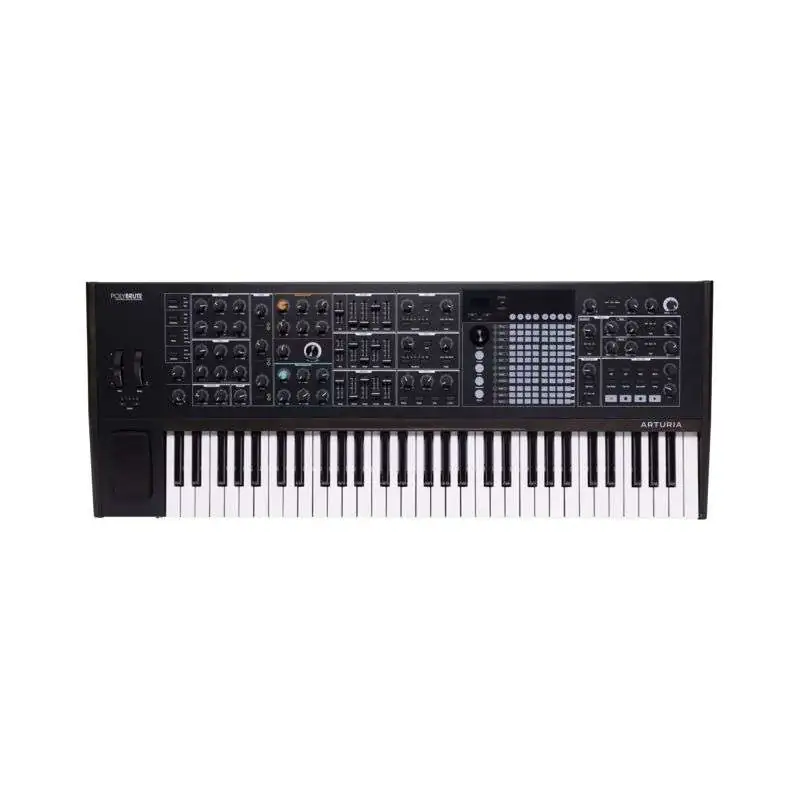
With the Polybrute Noir, Arturia makes a statement on the matter of synthesizers. In the style of the monophonic, but very opulent MatrixBrute, they now present the first, own polyphonic analogue synthesizer with the Arturia PolyBrute. The six-voice instrument shines with two analogue oscillators, two very different filters (Steiner-Parker and Moog-style) an extensive modulation matrix, a sequencer and some effects. The pleasantly playable keyboard spans over five octaves with 61 keys, is velocity sensitive and even has aftertouch. Sonically, the Polybrute covers a wide range of classic analogue sounds from the 70s to today. Thanks to the oscillators, which also offer mixable waveforms and of course don't miss the proven Metalizer, the basic sound alone is both modern and timeless. The large keypad with 12 x 8 controls fulfills different tasks depending on the mode. This is used to program the polyphonic sequencer, manage the stored sounds, assign the Morphing and set all modulation assignments. If you want to handle this storable flagship like a primal analogue synth, simply press the Panel Mode; from then on, what you hear corresponds to the current settings, regardless of what was in the memory space before. A real highlight in the Arturia PolyBrute is the morphing. It is possible to crossfade continuously between any two memory locations. Since with 768 presets enough sounds are available, you could e.g. save a variant of a sound with different oscillator levels and/or modulation intensities and morph between these two presets. Or you could make this change between a percussive Bass and a pulsating surface sound; you can let your creativity run wild.
The rich basic sound of the Arturia PolyBrute is created with two analogue oscillators that generate the Metalizer, Pulse Width and Sawtooth waveforms in parallel. Metalizer is primarily a triangle waveform with a wavefolder that generates harmonics that tend to have a metallic character as the value increases. Pulse Width is the classic square wave including pulse width modulation; the sawtooth more than lives up to its task; rich in overtones and punchy. Oscillator 2 also has a sub-oscillator. Between both oscillators, oscillator FM and Hardsync can be set continuously. Both tone generators and the tunable noise generator can be found in the mixer section, where the routing into the two filters is also determined for each signal source.
The colour-coded filters are Steiner-Parker State-Variable-Filter and 24dB Lowpass filters. The former is continuously variable from Lowpass via Highpass to Bandpass and has as an additional parameter the Brute Factor known from Arturia synthesizers, which is in concept a feedback circuit within the filter. Sonically, the SVF stands out by a very grainy sound with increasing resonance. The second filter is a classic 24dB Lowpass filter in the style of the Moog Ladder filter, which may be familiar to many from the Minimoog. The full and rich sound of the LPF is a classic of its kind in its own right. In addition, the second filter has a distortion and can be mixed continuously with the Steiner-Parker filter from serial to parallel in the signal path between mixer and VCA. Superior for both filters there is a master cutoff control with controllable keyboard tracking. If you need the Tracking for the filters in detail you can add this with a short grab into the modulation matrix.
You can see at first glance: no red pencil has been applied here. Next to the keyboard on the left side of the instrument, an X/Y/Z touch controller (aka Morphée) adorns the control panel. X and Y implement finger movements up, down, left and right, Z reacts to pressure. All three can be assigned to arbitrary destinations, which allows for the expressive and lively playing of the sounds. The ribbon controller is located centrally above the keyboard and measures just under half of the device's total length. Permanently assigned are the two intensity controls, which direct oscillator 2 to filter 1 and noise to filter 2. Two of the three loopable ADSR envelopes are permanently assigned to filters and VCA, but like almost all "generating functions" they can be linked to further destinations. Thanks to the fader design one can attest here: Form follows function. The modulation sources are joined by three BPM-synchronizable LFOs. The first two offer seven waveforms each and can act monophonic, polyphonic or triggered. LFO 1 can be shifted in the Phase and LFO 2 has an adjustable delay (Fade In). LFO3, on the other hand, can freely shape the waveform with Curve and Symmetry and can be switched to OneShot mode.
The effects section of the PolyBrute consists of delay, reverb, EQ and modulation effects and can be switched as insert or send. The Delay masters BBD and Pingpong modes, among others, and can be synchronized to the MIDI-Clock . The Reverb uses reverb, Plate and others and covers a wide range from gloomy atmospheres over industrial halls to the "middle Grand Canyon". The modulation effects include chorus, ensemble and Phaser and provide wafting and floating sounds. In addition, a knob can be used to distribute the played voices in the panorama; a psychoacoustic boon. :)
Each sound memory of the Arturia PolyBrute has a programmable polyphonic sequencer track, which can be up to 64 steps long and can be provided with Shuffle and other playback modes. In addition, there is an Arpeggiator with extensive playback capabilities and a motion recorder that can be used to record and automate parameters.


