- Ny



 Gratis fragt på tusindvis af varer
 100% sikre online betalinger
 30 dage til rådighed til at returnere varerne
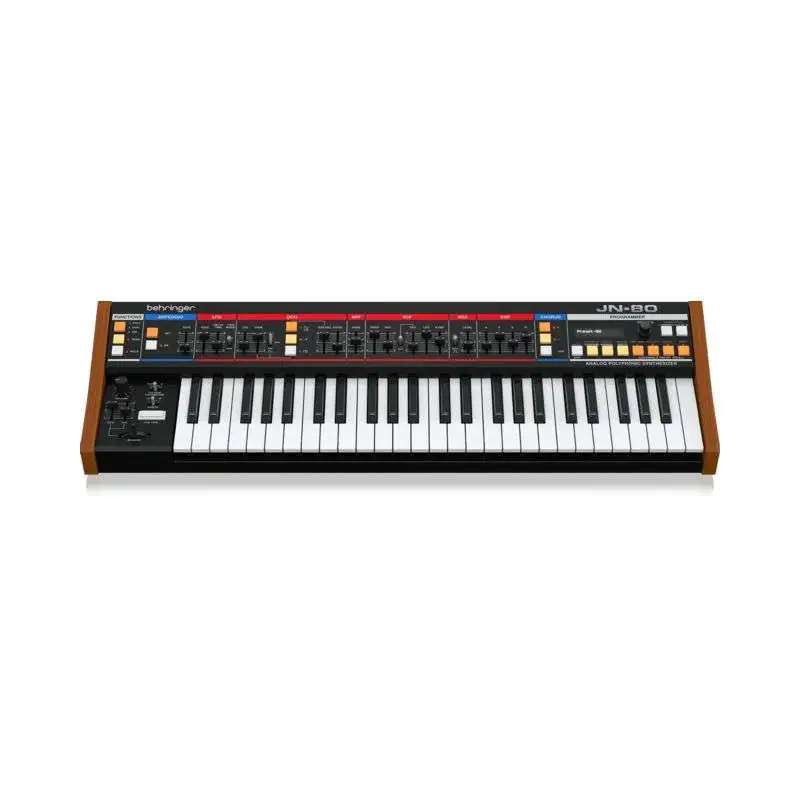
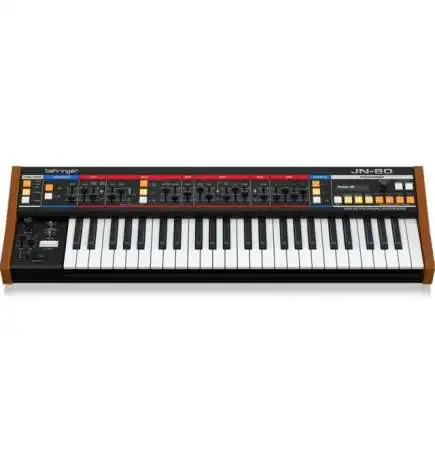
With the JN-80, Behringer presents a successful reproduction of the classic analog synthesizer Roland Juno-60 from 1982. Anyone who appreciates the structure and straightforward sound of old Roland Juno synthesizers will find exactly that in the JN-80. Apart from the programmer section, the layout of the control panel differs from the historical original only in details.
The simplicity of the classic subtractive signal path of the Juno synths is also responsible for their great popularity, as most settings can be used to produce "musical" results directly. Surfaces, pads, brass, basses and much more are part of the typical sound repertoire of the historic Juno series.
The reissue JN-80 scores with a significantly larger preset memory (400 instead of 56 memory locations), increased polyphony (8 instead of 6 voices), poly, duo and Unisono modes for voice distribution, the keyboard generates velocity and aftertouch and the much more compact form factor. Of course, the popular chorus effect, which plays a decisive role in the overall sound, has not been left out.
The 400 presets, which can be overwritten at will, are joined by Panel Mode; as soon as this is activated, the sound corresponds to the current controller settings. Thanks to the full MIDI implementation, the JN-80 can be automated by any DAW or master sequencer.
A voice of the JN-80 consists of an oscillator that generates the sawtooth and/or square waveforms with PWM, a sub-oscillator and the noise generator. This is followed by a resonance-free high-pass filter, which can be used to tame the bass range; the excellent-sounding 24dB Lowpass filter, which is based on a clone of the old Roland IR3109 chip, and the VCA. The latter is equipped with a replica of the BA662 chip and offers a choice of envelope or gate mode. This fulfills all the criteria for the typical Roland Juno sound. Finally, all voices are given the final touch with the charismatic Chorus effect. This is implemented as an analog BBD circuit and can be switched in two stages, as it should be. The ADSR envelope is permanently assigned to the filter, PWM and VCA. The LFO affects pitch, PWM and the filter. The menu also contains a handful of modulation assignments for Velocity and aftertouch. The voices can be played polyphonically, duophonically or Unisono .
Produktinformation