


 Δωρεάν αποστολή για χιλιάδες είδη
 100% ασφαλείς ηλεκτρονικές πληρωμές
 30 ημέρες διαθέσιμες για την επιστροφή των αγαθών
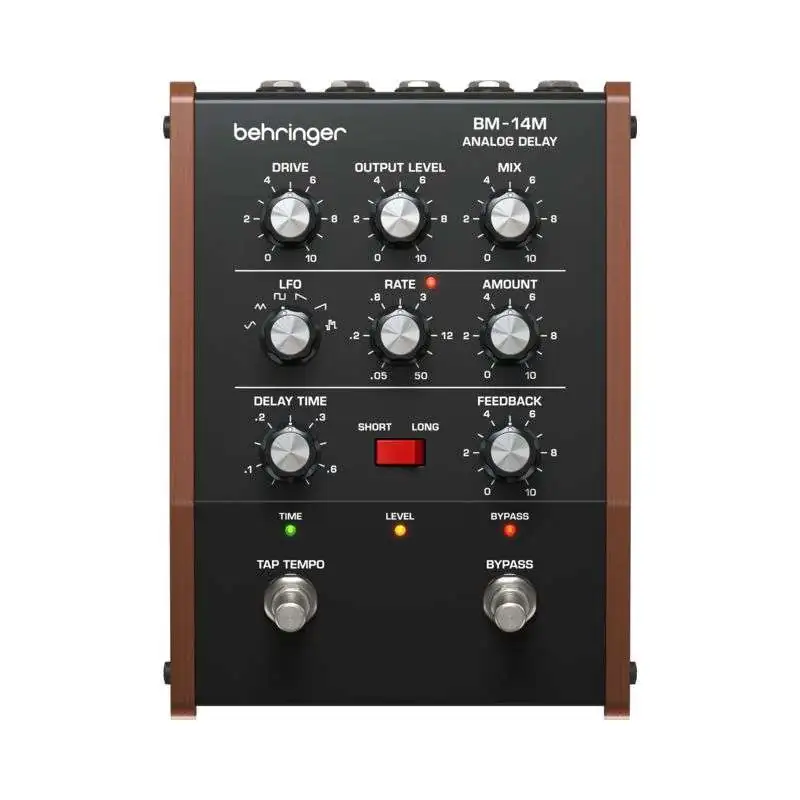
With the BM-14M analogue delay, Behringer presents a clone of the Moog MF-104M analogue delay from the popular MoogerFooger series. Behringer has succeeded in faithfully reproducing the special sound of the classic in all its details.
The BM-14M is an analog delay effect with a particularly lively and warm sound. The circuit is based on Bucket Brigade Device (BBD) technology, a series circuit consisting of capacitors and transistors that delay an audio signal in small steps by passing charges from one capacitor to the next, similar to a bucket brigade. The large toggle switch is used to switch between two bucket brigades of different lengths, resulting in the two delay modes Short and Long. Both modes sound very good and have their specific characteristics; due to the circuitry, BBD delays with shorter times have more treble in the sound. If you are looking for delays with a charismatic analogue sound, the BM-14M is the perfect choice!
Things get really exciting when you add the clock-synchronizable LFO, which modulates the TIME parameter. Its six waveforms produce effect variations that many guitar pedals have to match. Typical results are achieved with the sine and triangle waveforms. Square has a more switching character. Sawtooth and ramp provide rising or falling modulation curves. Stepped Random should appeal primarily to experimental musicians who consciously allow for random sound shifts.
The input stage is designed for line and guitar levels and can be overdriven, in most cases this sounds very musical and has a harmonic character.
The connections are the same as on the original: there are five CV/expression inputs for the parameters Feedback, Time, LFO Rate, LFO Amout and Mix. This allows the parameters to be controlled via an expression pedal or any control voltages from the modular system. The audio input is mono, there are two audio outputs: Mix Out carries the continuously mixable effect signal, Delay Out the pure effect signal. At the Feedback insert, you can intervene in the feedback path with a Y-cable. A separate EQ or filter provides amazing results. The LFO can be synchronized to MIDI Clock via the MIDI input and all parameters can also be controlled via Control Change commands.
Χαρακτηριστικά