




 Gratis fragt på tusindvis af varer
 100% sikre online betalinger
 30 dage til rådighed til at returnere varerne
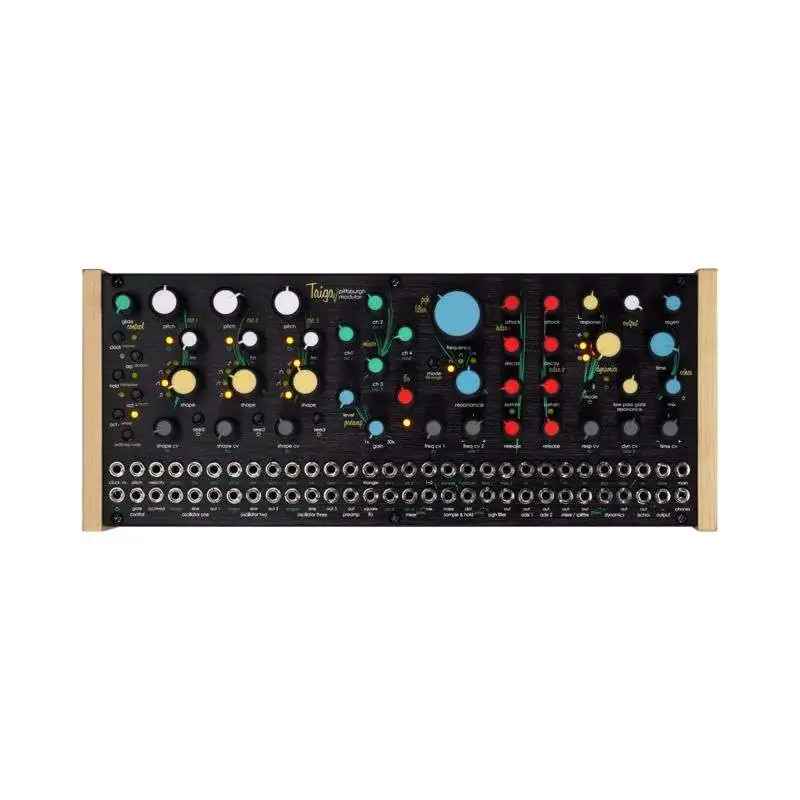
With Taiga, Pittsburgh Modular presents a semi-modular analogue synthesizer that opens up its full potential with the use of patch jacks. The instrument is monophonic or three-voice paraphonic playable, clearly structured and addresses beginners and professionals alike with its architecture. All control voltage inputs and outputs are Eurorack compatible. Of course Taiga also works without patch cables plugged in, the green labels on some jacks and knobs indicate pre-wiring (normalized signal paths) which are only used elsewhere by patching.
The three analogue oscillators are equipped in the same way and offer besides pitch control, FM input and waveform selection also Shape CV, which corresponds to a waveshaper. For the square wave this means classic PWM, for triangle the result tends towards cloud generator and for sawtooth to simple supersaw. One waveform per oscillator can be active at the same time, but there is an additional sine output, which outputs an accurate waveform compared to the waveshaper sine. Since all signal paths are normalized, oscillators 1-3 and the noise generator are connected to the mixer together.
Part of the mixer is a preamp for external audio signals with line level. It works with high gain and is able to roast incoming signals properly before they are processed with the sound shaping elements of Taiga and thus open up completely new worlds of sound.
The signals from the mixer and Preamp can be tapped separately and end up in the "No-Dead-Spots" multimode filter, which offers lowpass, Bandpass and Highpass , allows the combination of several filter modes at the same time and shines with a very organic sound.
The VCA alias Dynamics does more than one is used to from most VCAs. It can act classically as a VCA and be modulated via envelope, or it can be used as an LPG or Plucked LPG. In plain language we are dealing with a Low Pass Gate . This is very popular especially for modules and synthesizers with Buchla context, because not only the level is modulated but also a special filter is present in the circuit. The combination is known for percussive sounds with a wooden sound (Buchla Bongos!), and has a completely different effect in the result than most VCAs could do.
The last element in the signal path is an analog BBD echo, whose delay time can be modulated via CV. The range goes from nice echo effects from the 70s to flanger-like with very short delay times to wild chaos sounds, depending on which modulation source is in use.
With all the possibilities, it almost seems like the modulation sources are getting short shrift. Two nimble ADSR envelopes, an open Sample & Hold circuit and an LFO with triangle and square waveforms with a frequency range of 2-5000 Hertz catch the eye of the beholder. If you keep in mind that the three oscillators and the MIDI interface are also modulation sources and other semi-modular synthesizers and / or a Eurorack modular system can be easily integrated, then all doors to sound exploration are open.
The MIDI interface of Taiga is equipped pleasingly extensively for this device class. Standards like an assignable MIDI channel and transposition can be found here as well as a clock-synchronous arpeggiator, clock divider and a pseudo-random sequencer mode. The latter cuts a fine figure especially when Taiga is used on its own in an experimental context. Of course, the MIDI interface is also pre-wired with parts of the sound generation. The oscillators, for example, can be decoupled from Tracking . If you prefer to modulate a parameter with Velocity or the modulation wheel instead of a normalized modulation source, all you need to do is plug in a cable.
The patch panel with a total of 60 sockets takes up the entire width of the lower third of the user interface. Each function has (several) inputs and outputs for audio, CV, gate, trigger and clock signals. Often two or three cables are enough to turn the sound completely upside down. If you connect any oscillator output to the FM input of the other oscillator, you get cross-modulation, which is useful for metallic sounds. If the cable goes into the filter instead of an oscillator, the result is filter FM, which is one of the most extreme modulations. It also gets exciting when the VCA is modulated by an oscillator in the audio section, which produces amplitude modulation respectively sideband modulation. Since the MIDI CV/Gate interface also outputs control voltages, the filter could also be played with Keytracking while the waveform of oscillator 2 is animated with Velocity , for example. These examples cover only a small part of what Taiga alone is capable of.
Produktinformation

