





 Free shipping on many items. Customs fees are always included. No additional delivery charges
 100% secure online payments
 30 days available to return the goods
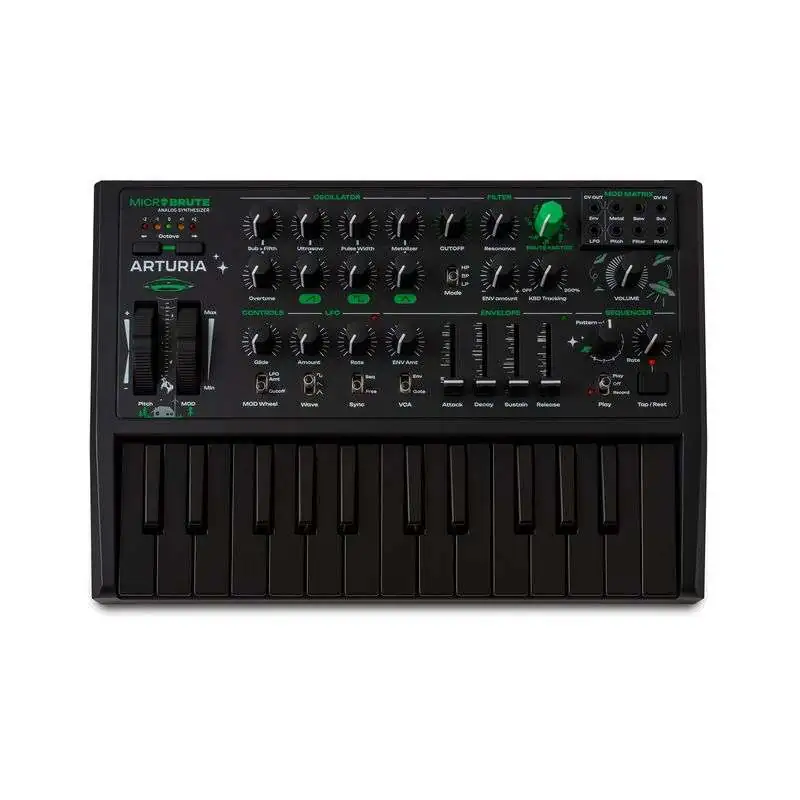
The Arturia MicroBrute is a compact, fully analog synthesizer with a 25-key keyboard. The clear layout makes working with the synthesizer intuitive, with a clear focus on the fun of tweaking sounds. The instrument can be integrated into various setups via MIDI In and USB MIDI. Thanks to the CV / Gate control voltage outputs, the MicroBrute also cuts a fine figure as a master keyboard for a Eurorack modular system.
In the UFO edition, the MicroBrute and its keyboard are completely black. The user interface is decorated with nerdy UFO and space graphics and the poison green BRUTE knob stands out visually.
The analog sound generation of the MicroBrute is a specialty of its own: The signal path consisting of oscillator including sub-oscillator, filter and VCA is based on the Roland classic SH-101, but goes its own way in terms of sound.
The oscillator simultaneously generates the sawtooth, square and triangle waveforms, which are implemented here as Ultrasaw (superimposed, multiple sawtooth), Pulse Width (classic PWM) and Metalizer (downstream wavefolder). A sub-oscillator with a square waveform, which oscillates an octave below the oscillator, provides more punch in the bass range, but can also be turned up to the "fifth" to create 2-tone pseudo-chords.
As the mixer is integrated into the oscillator block, the next step is a wonderful vintage sounding Steiner-Parker Multimode filter with lowpass, bandpass and highpass characteristics. The filter circuit comes from the Steiner-Parker Synthacon synthesizer from 1975 and is characterized by a particularly pithy resonance and musical overdrive behavior. The filter has been extended by the BRUTE control, which corresponds to an adjustable feedback loop between the filter output and input and provides the heavy sounds.
The last element in the signal path is the VCA, which works in the envelope or Gate-Mode mode.
When it comes to modulation, the MicroBrute is more flexible than you might think at first glance. The ADSR envelope is hardwired to the filter and VCA. The LFO has three waveforms and can run freely or be synchronized to MIDI-Clock . Both modulation sources also appear in the mod matrix at the top right. The six control voltage inputs are assigned to the Ultrasaw, Pulse Width, Metalizer, Sub, Pitch and Filter parameters. Simply connect the supplied patch cables from Out to In and turn up AMOUNT for LFO and envelope until it fits. The modulation wheel can control either the LFO intensity or Cutoff . The internal step sequencer has eight memory locations with a pattern length of up to 64 steps; this is more suitable for jam sessions and creating sound sequences freehand.
Data sheet


