




 Livrare gratuită pentru mii de articole
 Plăți online 100% sigure
 30 de zile disponibile pentru returnarea bunurilor
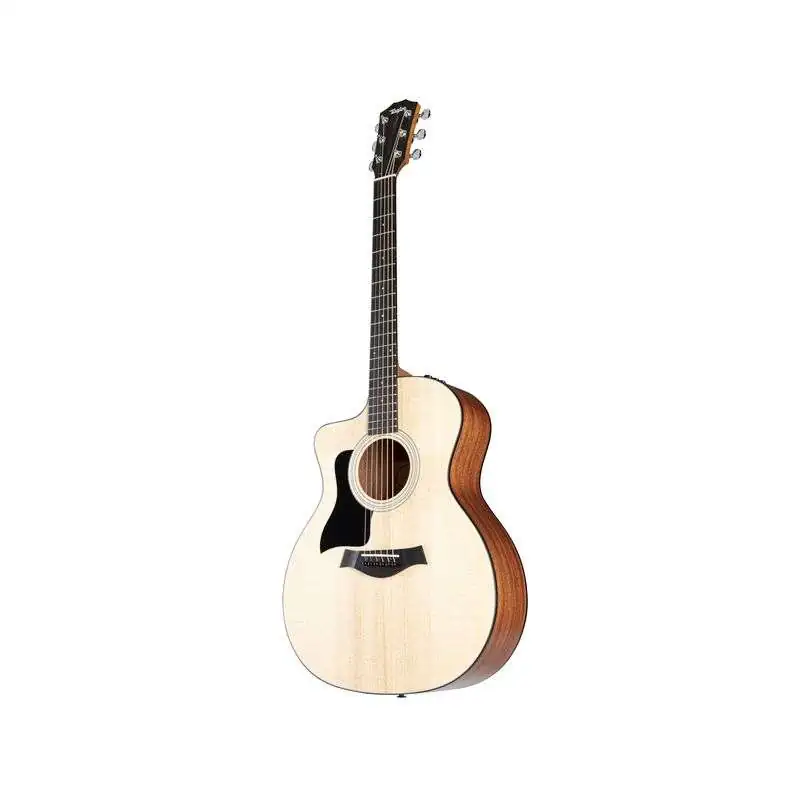
With the Taylor 114ce-S Lefthand, the US-American manufacturer presents its latest acoustic guitarAcoustic guitar:
The acoustic guitar is an acoustic guitar with steel strings. It is often used for folk of the 100 series, which brings a breath of fresh air to the popular series with new features. The Grand Auditorium model for left-handers comes with its classic solid Sitka spruce topTop:
The top is the upper part of the guitar body, but this time with a laminated Sapele bodyBody:
The body is the body of a guitar. It is made of wood and influences the sound and resonance of the instrument. The sound of a guitar can vary depending on the shape and material of the body.. The characteristic sound properties of the tonewoodsTonewood:
Tonewood is the wood from which the body of a guitar is made. It influences the sound and resonance of the instrument. Popular tonewoods are mahogany or maple produce a powerful acoustic sound for expressive vocal accompaniment and virtuoso solo playing. To ensure that live enthusiasts also get their money's worth, the guitar is equipped with the in-house Expression System 2 for professionally amplified playing and is furthermore supplied in a well-padded gig bagGig bag:
guitar bag which makes storage and transportation safe and uncomplicated.
New in the 100 series is the laminated body made of Sapele, which produces a strikingly bright tone due to the high density of the wood species, but also has a clear warmth of sound in the mids and basses. The trebles are additionally emphasized by the solid Sitka spruce top, which is not the most popular and most frequently used top wood for high-quality instruments in guitar making for nothing.
The Grand Auditorium design is the ideal compromise between the voluminous Dreadnought and the compact Grand Concert. It combines sonic assertiveness with great balance and a handy shape. This advantageous design makes the Grand Auditorium one of the most popular guitar shapes, preferred by master guitarists such as Eric Clapton.
The Forward Shifted PatternCeiling bracing:
Bracing enriches the model with an innovative premium feature. The intersection point of the bars is a few mm closer to the sound holeSound hole:
The sound hole is an opening on the front of a guitar. It allows the sound produced by the strings to reach the outside and amplify the sound of the guitar., creating a larger soundboard area behind the bracing. This results in improved vibration behavior, which gives the sound additional volume that benefits an expressive stage presence.
Maple is one of the most stable woods for guitar necksGuitar neck:
Maple neck and adds compact bass to the sound. With its nut widthNut width:
Nut width refers to the distance between the outermost strings at the top of a guitar's fretboard. A wider nut allows the strings to be placed further apart of 42.8 mm, the slim neck sits comfortably in the hand and perfectly meets the requirements for powerful strummingStrumming:
Strumming is a guitar playing technique in which you strike the strings with your fingers or a pick at regular intervals to create a rhythm. Different strumming techniques and patterns create the typical sound of the rhythm guitar. and skillful flatpicking. Meanwhile, the velvety ebony fingerboardFretboard:
The fretboard is the part of the guitar on which the strings are fretted to produce different tones. It is made of wood and has metal frets that mark the different pitches. allows the fretting hand to glide effortlessly over all 20 fretsFret:
Jumbo frets, as the generous cutawayCutaway:
A cutaway is a recess in the body of a guitar that allows the guitarist to reach the higher frets more easily. This makes it easier to pick and play the strings in the upper registers. even the high positions are freely accessible.
The Expression System 2 is Taylor's in-house development and is a masterpiece in the field of pickupsPickup:
A pickup is an electronic component that converts the vibrations of the guitar strings into electrical signals. These signals are then amplified and played back via loudspeakers to make the sound of the guitar audible. for acoustic guitars thanks to its well-thought-out functionality. Three piezo elementsPiezo pickup:
A piezo pickup is an electronic component that converts vibrations from guitar strings into electrical signals. It is often used in acoustic guitars to amplify the sound. The pickup consists of a piezo crystal that is made to vibrate by the vibrations of the strings. pick up the acoustic signals of each pair of strings directly and thus transmit an unadulterated sound. Volume, bass and treble can be individually adjusted using three controls, which are also discreetly integrated into the frameFrame:
The frame is the side part of the guitar body that surrounds the cavity. It is usually made of wood and contributes to the stability and resonance of the guitar..
In order to optimally withstand the solid string tension, acoustic guitars have additional reinforcing elements in addition to the truss rod. For example, the Taylor 114ce-S Lefthand is equipped with a stable ebony bridgeBridge:
Bridge with Micarta bridge inlaySaddle:
The saddle is a small piece of material that is placed in the bridge of a guitar. It helps to keep the strings at the right height above the fretboard and ensures a clear sound and good playability of the guitar., which reliably withstands high forces. The compensated saddle creates a flat string positionString action:
The string action refers to the distance between the guitar strings and the fretboard. A low string action makes the guitar easier to play, which makes it easier to pick up and ensures clean intonationIntonation:
Intonation refers to the correct tuning of the individual strings of a guitar. Adjusting the scale length ensures that all notes played on a string sound at the correct pitch., while robust die-castTuners:
die-cast tuners chrome tunersTuners:
die-cast tuners guarantee lasting tuning stability.
As one of the largest guitar manufacturers, Taylor is a true authority in the production of first-class instruments. Professional production by trained specialists results in the finest products for life, whose value is always maintained - or even increases! This is due in equal part to the exquisite tonewoods, which do not warp due to long storage and selected quality and are therefore hard to beat in terms of high quality. Only spruce, mahogany, cedar or Koa of proven quality are used for the tops. Careful production in combination with the best materials does not only apply to guitars. Guitar bags and all accessories are also of first-class quality. Finally, a conscientious final inspection does not allow even the smallest defects to slip through and ensures absolutely flawless guitars before dispatch.
As if that were not enough, Taylor also attaches great importance to acting in an environmentally conscious manner.
Uncontrolled deforestation and overexploitation lead to massively endangered wood species that can no longer regenerate due to the high rate of extraction. These include ebony and koa in particular, whose dwindling stocks and the resulting ecological problems have prompted a rethink at Taylor Guitars.
As ebony is particularly finger-friendly due to its hard, supple texture, it has long been the preferred choice for the production of fingerboards. Its attractive appearance is also extremely popular for bridges, headstock overlays, bridge Pins and Bindings . However, the high demand and the flourishing black market outstripped stocks, so that ebony ended up on the Red List of endangered species in 1994. In addition, only the deep black heartwood, which makes up only a fraction of the tree, was used, resulting in a disproportionately large amount of waste in production. To protect the forests, Taylor has been working with the Crelicam Wood Mill in Yaoundé, Cameroon, since 2011 to promote controlled consumption by processing waste products. Thus, Taylor guitars not only contain black ebony elements, but also the different colored, more clearly grained parts of the tree. This complete recycling is an effective method of preserving the stocks and successfully counteracts their dramatic decline and the associated negative ecological effects.
"We need to use the ebony that the forest gives us" - Bob Taylor
The koa acacia population has also suffered heavy losses over the last 20 years. Unsustainable forestry and overexploitation have led to a decline that can only be halted through proactive action and reforestation. This is why Taylor Guitars, together with Pacific Rim Tonewoods, founded the Siglo Tonewoods project, which aims to rebuild the Hawaiian jungle. This is a large cultivation area for koa acacia and other species, which enables the use of koa wood on a controlled scale.
Fisa tehnica


