

 Fri frakt på tusentals varor
 100 % säkra onlinebetalningar
 30 dagar tillgängliga för att returnera varorna
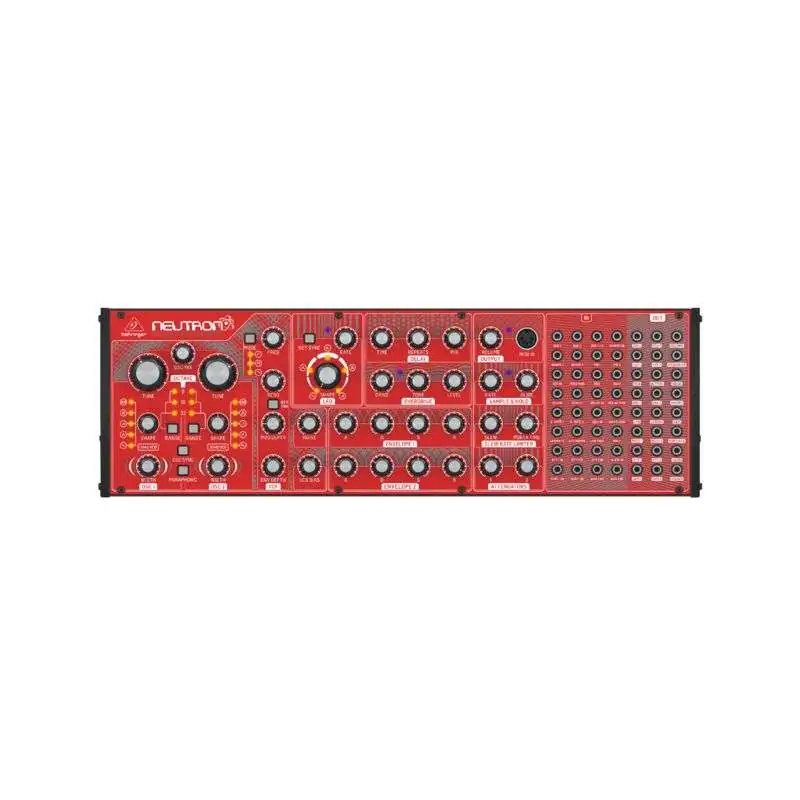
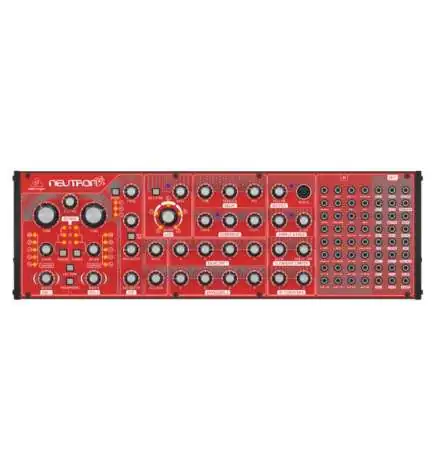
The Behringer Neutron is a semi-modular and paraphonic synthesizer in desktop format. The synthesizer has 2x analogue oscillators based on the legendary CEM3340 chips from Doug Curtis. In addition, there is a multimode VCF, 2x ADSR envelopes, an LFO with 5x waveforms and a delay based on the bucket brigade delay technique. On the right side there is a matrix with 32x CV inputs and 24x CV outputs, with which the internal wiring can be broken up to integrate the Neutron into modular Eurorack synthesizer environments.
Dual Oscillators
2x CEM3340 chips were installed in the Behringer Neutron. These oscillators were used in synthesizer classics like the Roland SH-101 or the Jupiter 6, the Moog Memorymoog or the Oberheim OB-8 and OB-Xa. The chips can be controlled independently and have 5x waveforms: Tone Mod, Square, Sawtooth, Triangle and Sine. Seamless crossfading is possible between the waveforms.
Multimode VCF
The multimode filter of the neutron has a slope of 12 dB/Oct and has a high/low-pass output. If the filter is turned up sufficiently, it can be brought to self-oscillation. Furthermore, the multimode VCF of the neutron can be additionally modulated with one of the two ADSR envelopes. Thus its function goes far beyond that of a normal filter.
Patch Matrix
The Behringer Neutron is equipped with an extensive patch matrix, which allows to break the internal pre-wiring and to give the synthesizer its own individual touch. One of the special features of the patch matrix is a sample & hold function with additional glide, which ensures even more creativity.
Since the worldwide demand for the Neutron is very high, we will unfortunately not be able to serve all pre-orders with the first delivery. It is recommended to order early and join the queue.
The main features of the Behringer Neutron include:
Datablad